Something shifted in 2026.
Not in a loud, hype-driven way — but in a structural, foundational way.
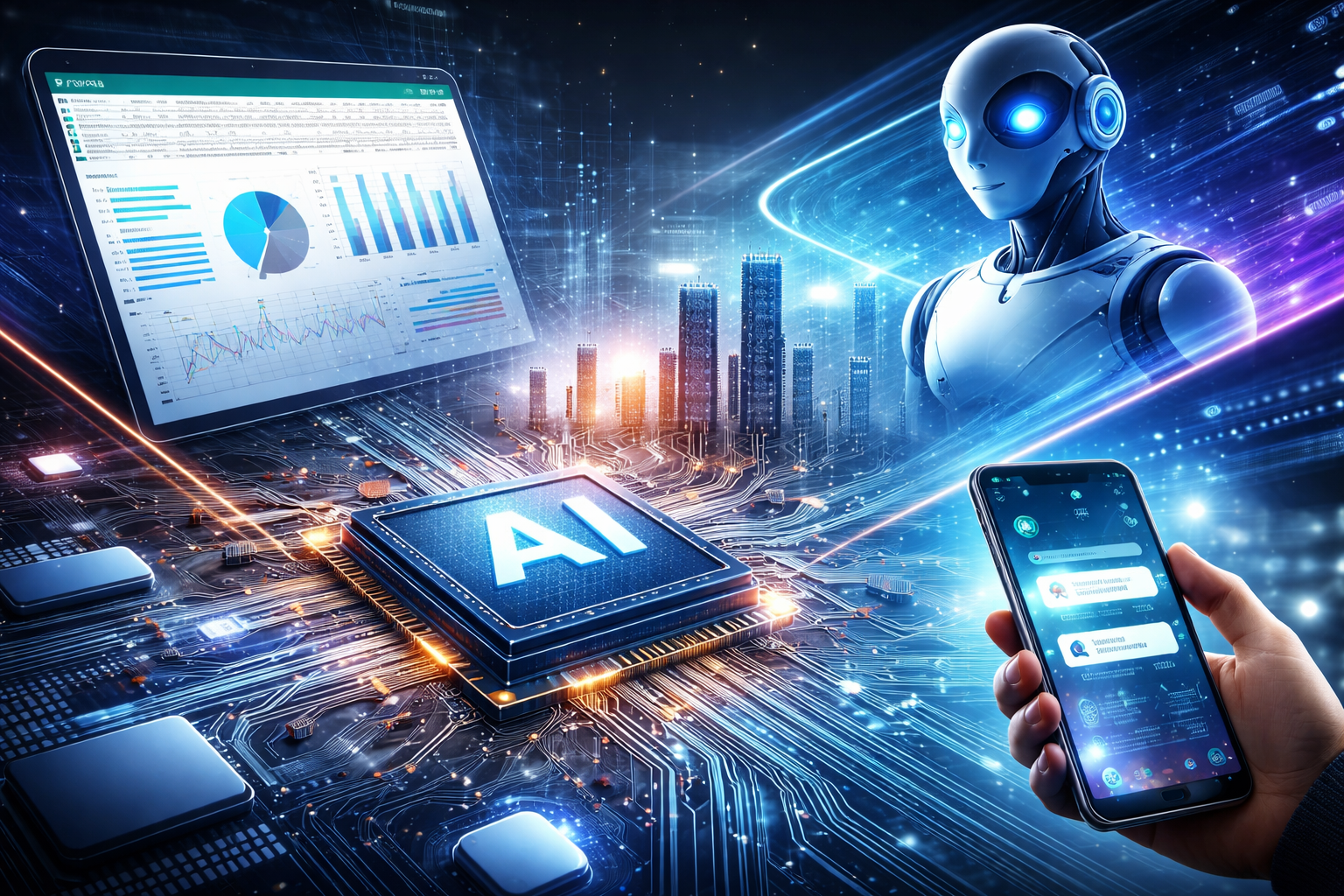
Artificial intelligence is no longer just a chatbot in a browser tab. It’s becoming infrastructure. It’s moving into spreadsheets, project dashboards, smartphones, enterprise software, and even the hardware layer powering everything behind the scenes.
If 2023 and 2024 were about experimentation, and 2025 was about integration, 2026 is about consolidation and acceleration.
In this breakdown, we’ll look at the most important AI trends 2026 is shaping right now — and more importantly, what they actually mean for entrepreneurs, small businesses, and productivity-driven teams.
1. Nvidia’s New AI Chips: The Infrastructure Race Gets Serious
One of the most overlooked but critical AI trends 2026 is unfolding at the hardware level.
Nvidia is preparing a new generation of AI inference chips — processors optimized not just for training massive models, but for running them efficiently at scale.
👉 In the article where we analyzed the rise of AI agents in business, we discussed how execution speed and cost efficiency determine whether AI remains a “tool” or becomes an operational backbone. This new hardware wave makes that shift possible.
What does this mean in practical terms?
- Faster AI responses
- Lower compute costs for SaaS providers
- More affordable AI-powered software for businesses
- Increased competition among AI vendors
When infrastructure improves, applications evolve faster. That’s exactly what we’re seeing now.
2. AI Inside Excel, PowerPoint and Slack: The Workplace Is Changing
For years, AI lived in separate apps.
Now, it’s moving directly into the tools people already use daily.
Anthropic recently announced enterprise integrations allowing Claude to operate inside platforms like Excel, PowerPoint, and Slack. Microsoft continues expanding AI copilots across its ecosystem.
This is not just a feature upgrade.
It’s a behavioral shift.
Instead of:
- switching tabs
- copying data
- prompting externally
Users interact with AI directly inside workflows.
This is one of the most important AI trends 2026 because it removes friction.
When AI becomes embedded rather than external, adoption accelerates.
Recent enterprise updates show major AI models being integrated directly into productivity platforms like Excel and Slack → https://www.businessinsider.com/anthropic-ai-software-claude-microsoft-powerpoint-excel-slack-2026-2
For small businesses, this means:
- Automated reporting
- Instant summarization of long threads
- AI-generated project plans
- Smart financial modeling
If you’ve read our breakdown of the best AI project management tools in 2026, you’ve already seen how embedded AI features are becoming a deciding factor when choosing software.
3. AI Agents Are Becoming Semi-Autonomous Operators
Another key theme in AI trends 2026 is the rise of agent-based systems.
Unlike traditional chat models, AI agents can:
- Execute tasks
- Interact with APIs
- Automate workflows
- Chain actions together
This matters because businesses don’t need more answers — they need outcomes.
We explored this idea deeper in our article about how AI agents are reshaping productivity workflows.
The difference between a chatbot and an agent is execution.
An agent doesn’t just tell you what to do. It can do part of it for you.
But here’s the nuance many miss:
AI agents are not replacing managers or founders.
They are becoming leverage tools.
When paired correctly with human oversight, they increase operational bandwidth without removing strategic control.
That’s a key narrative shift happening in 2026.
4. Smartphones Are Becoming Multi-Agent Ecosystems
AI is no longer confined to desktops.
Samsung recently expanded Galaxy AI integrations, bringing in multiple AI systems including Perplexity alongside existing assistants.
This signals a move toward multi-agent mobile ecosystems.
Tech reports indicate that smartphone manufacturers are now integrating multiple AI systems into a single device environment, signaling a broader shift toward AI-native mobile ecosystems → https://timesofindia.indiatimes.com/technology/tech-news/samsung-expands-galaxy-ai-with-perplexity-joining-bixby-and-gemini/articleshow/128704522.cms
For users, this means:
- Context-aware assistance
- Real-time research
- Smart content generation
- Multi-modal interactions
For entrepreneurs, it means AI is becoming ambient.
The barrier between user and intelligence is shrinking.
5. The Psychological Shift: From Fear to Augmentation
There’s another major development in AI trends 2026 — and it’s not technical.
It’s cultural.
Organizations like the IMF and major financial institutions have publicly discussed AI’s impact on jobs, productivity, and labor markets.
But the narrative is evolving.
Instead of pure replacement anxiety, there’s growing focus on augmentation.
The reality in business environments is more nuanced:
- Routine tasks are automated
- Strategic tasks remain human
- Productivity expands
- Skill requirements shift
In our earlier analysis of whether AI will replace jobs or transform them, we explored this dynamic in depth.
The conclusion remains consistent:
AI amplifies leverage.
Humans retain judgment.
6. What This Means for Small Businesses in 2026
If you run a small or mid-sized business, here’s the practical takeaway from all these AI trends 2026 signals:
- Infrastructure is improving → software will get cheaper and faster
- AI is embedding into daily tools → friction decreases
- Agents will automate repetitive workflows
- Mobile AI expands access
- Human strategy remains critical
The competitive edge won’t belong to companies with the most AI tools.
It will belong to companies that:
- Integrate AI selectively
- Maintain oversight
- Focus on ROI
- Combine automation with clarity
We’ve tested dozens of tools across project management, content creation, and automation — and the pattern is consistent.
AI is powerful.
But only when applied intentionally.
Final Thoughts: AI Trends 2026 Are About Structure, Not Hype
2026 is not about louder marketing.
It’s about deeper integration.
Hardware acceleration.
Embedded intelligence.
Agent execution.
Mobile ecosystems.
Human-AI collaboration.
If you treat AI as a gimmick, you’ll get marginal gains.
If you treat it as infrastructure, you’ll build leverage.
And that distinction will define who scales — and who stagnates — in the years ahead.

Andrew Black is the founder of DipFeed, a digital publication focused on artificial intelligence tools, software reviews, and workflow optimization. He researches and analyzes how AI reshapes productivity, business processes, and modern work in 2026. His work emphasizes practical testing, real-world use cases, and evidence-based insights rather than hype or speculation.