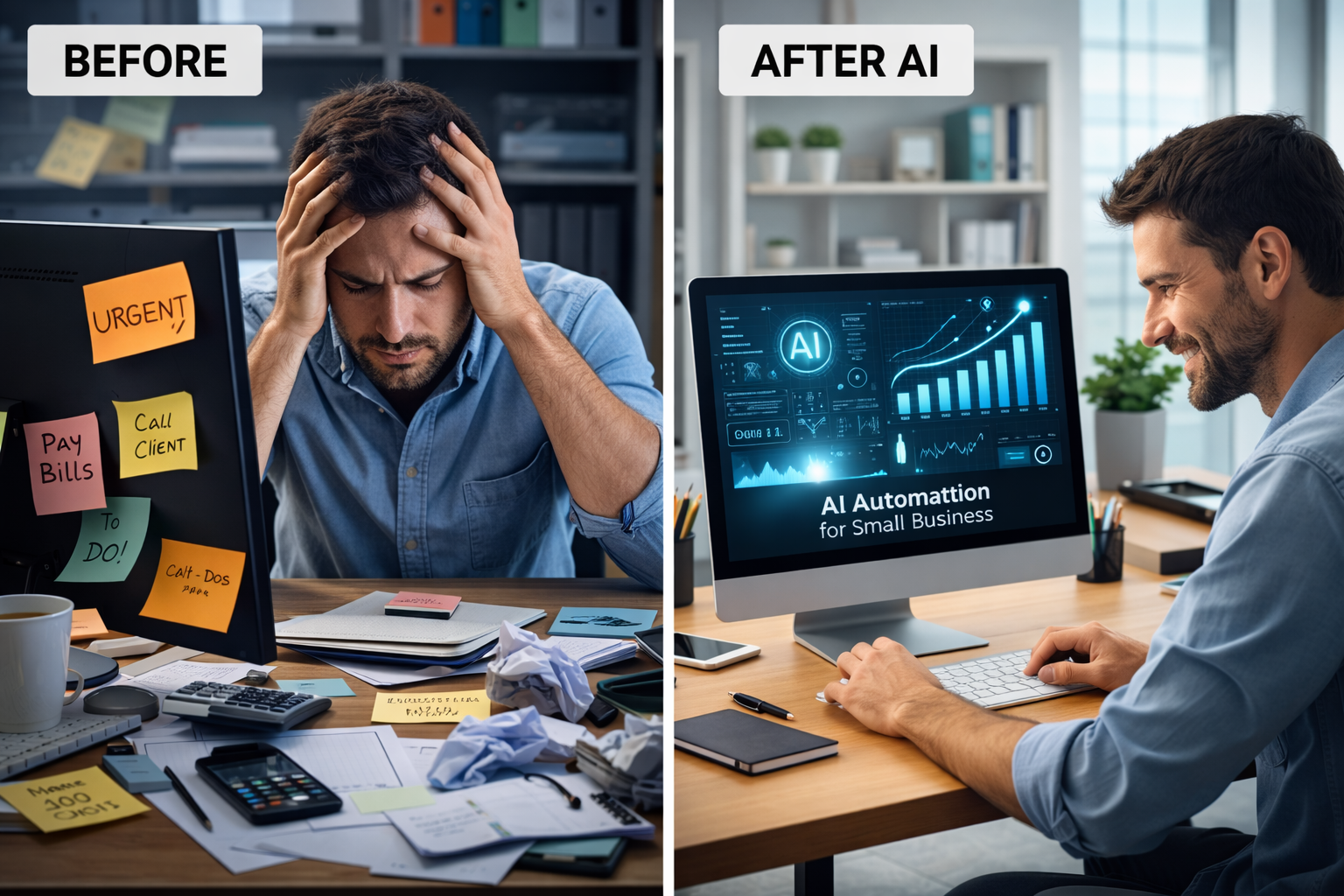
Small businesses don’t fail because they lack ideas. They fail because they run out of time, systems, and leverage.
In 2026, leverage comes from AI.
The best AI tools for small businesses in 2026 are no longer experimental productivity boosters. They directly impact revenue, automate operations, improve marketing performance, and eliminate repetitive work that drains founders and small teams.
But here’s the problem.
There are hundreds of AI tools. Most promise “automation.” Very few actually deliver ROI.
This guide cuts through the noise.
We tested, analyzed, and compared the most practical AI tools — not based on hype, but based on real-world business impact.
If you run:
- a startup
- a small marketing agency
- a SaaS project
- an e-commerce store
- or a service-based business
This article will save you hours of research — and potentially thousands in wrong tool subscriptions.
Let’s break it down properly.
What Are the Best AI Tools for Small Businesses in 2026?
The best AI tools for small businesses in 2026 are ChatGPT, Jasper AI, ClickUp AI, HubSpot AI, and Notion AI. These tools help automate marketing, project management, CRM processes, documentation, and revenue-generating workflows.
They are considered the most effective because they offer measurable ROI, scalability, and integration with existing business systems.
What Makes the Best AI Tools for Small Businesses in 2026?
Not every AI tool deserves a place in your tech stack.
To qualify for this list, tools had to meet 5 strict criteria:
1. Direct ROI Potential
Can this tool:
- increase revenue?
- reduce labor cost?
- automate revenue-generating processes?
If not, it’s noise.
2. Ease of Implementation
Small businesses don’t have IT departments.
If it takes weeks to set up, it’s not practical.
3. Scalability
The tool must work for:
- 2-person teams
- 10-person teams
- growing startups
4. Integration Ecosystem
The best AI tools connect with:
- CRM systems
- project management tools
- marketing platforms
- email systems
5. Cost-to-Value Ratio
Expensive tools are fine — if ROI justifies them.
If you’re curious how AI productivity compares to classic software models, you can explore our AI productivity tools compared to traditional software analysis for deeper context.
Now let’s move to the real comparison.
Best AI Tools for Small Businesses in 2026 (Compared & Ranked)
Here are the tools that consistently generate measurable business impact.
- ChatGPT – Best overall AI assistant for business
- Jasper AI – Best for marketing automation
- ClickUp AI – Best for AI-powered project management
- HubSpot AI – Best for CRM & sales growth
- Notion AI – Best for internal systems & documentation
1. ChatGPT (Best for Content, Automation & Idea Execution)
ChatGPT has evolved far beyond a chatbot.
For small businesses, it can:
- Write sales pages
- Draft marketing emails
- Generate ad copy
- Create SOPs
- Build automation logic
- Assist in coding
- Generate client proposals
In practical terms, it replaces:
- a junior content writer
- part of your marketing assistant
- and sometimes even a consultant
The key difference in 2026?
Structured workflows and API integrations make it scalable.
To explore full product features and pricing details, visit the official ChatGPT website.
If you want a real-world comparison between ChatGPT, Claude and Gemini, we’ve already broken that down in detail.
2. Jasper AI (Best for Marketing Teams & Agencies)
Jasper focuses on structured marketing output.
For small businesses running ads or content-heavy funnels, Jasper helps with:
- Ad creatives
- Long-form blog content
- Landing pages
- Brand voice consistency
Its real strength is repeatable content production at scale.
If your business depends on consistent marketing output, Jasper can reduce outsourcing costs dramatically.
You can review Jasper’s latest features and pricing structure directly on their official website.
3. ClickUp AI (Best for AI-Powered Project Management)
Execution kills small businesses more often than bad ideas.
ClickUp AI helps with:
- Auto-generated task summaries
- Project breakdowns
- Meeting recap automation
- Smart documentation
- Workflow suggestions
The real value?
It removes friction in team coordination.
ClickUp’s AI capabilities and automation features are explained in detail on their official platform page:
If you’re looking for a more complete AI project management breakdown, we’ll be publishing an expanded comparison soon.
4. HubSpot AI Tools (Best for Sales & CRM Automation)
Revenue automation is where AI becomes extremely powerful.
HubSpot integrates AI into:
- Email personalization
- Lead scoring
- Content generation
- CRM automation
- Predictive analytics
For service businesses and B2B startups, this is a serious revenue multiplier.
HubSpot’s AI-powered CRM features are fully documented on the official HubSpot product page.
5. Notion AI (Best for Internal Knowledge & Systems)
Small businesses rarely fail from lack of ideas.
They fail from chaos.
Notion AI helps you:
- Build structured documentation
- Summarize internal meetings
- Generate SOP drafts
- Create internal wikis
- Organize operations
For small remote teams, this becomes a silent productivity engine.
For a complete breakdown of Notion AI capabilities, check the official Notion AI page:
AI ROI Breakdown for Small Businesses
Let’s quantify impact.
| Tool Type | Primary Benefit | Estimated ROI Impact |
|---|---|---|
| Content AI | Faster marketing output | 2–5x content velocity |
| CRM AI | Higher conversion rates | +10–30% revenue lift |
| Project AI | Reduced execution delays | 20–40% efficiency gain |
| Documentation AI | Lower onboarding time | 50% faster training |
This is why the best AI tools for small businesses in 2026 are not optional anymore.
They are competitive advantages.
Quick Comparison at a Glance
- Best for content: ChatGPT
- Best for structured marketing: Jasper
- Best for team execution: ClickUp
- Best for revenue automation: HubSpot
- Best for knowledge systems: Notion
Are AI Tools Worth It for Small Businesses?
Short answer: yes.
Long answer: only if implemented strategically.
AI tools fail when:
- bought impulsively
- used without process
- layered without integration
They succeed when:
- aligned with revenue activities
- tied to measurable metrics
- embedded into daily workflow
If you’re still unsure how modern AI systems differ in capability, our detailed AI comparison guide can help clarify performance differences between major platforms.
How to Choose the Right AI Tool for Your Business
Before subscribing to anything, ask:
- What business process wastes the most time?
- What activity directly impacts revenue?
- Can AI reduce cost or increase output in that area?
Start with one tool.
Measure impact for 30 days.
Then expand.
Small businesses don’t need 15 AI tools.
They need 3 that work properly.
Final Verdict: Which AI Tool Should You Choose?
If you are:
- A content-driven business → Start with ChatGPT or Jasper
- A service company → Add HubSpot AI
- A team-based startup → Use ClickUp AI
- A remote-first company → Integrate Notion AI
The best AI tools for small businesses in 2026 are those that replace friction, not just add features.
AI isn’t magic.
It’s leverage.
And small businesses that adopt leverage early scale faster.
According to industry research from major consulting firms such as McKinsey and Gartner, AI adoption among small and mid-sized businesses is accelerating faster than enterprise-level deployment.
Frequently Asked Questions About AI Tools for Small Businesses
What is the best AI tool for small businesses in 2026?
The best AI tool for small businesses in 2026 depends on the business model, but ChatGPT remains the most versatile option for content creation, automation, and operational efficiency.
Are AI tools affordable for startups?
Most modern AI tools offer scalable pricing models, making them accessible even for early-stage startups.
How much ROI can AI generate?
When properly implemented, businesses report productivity increases between 20% and 40%, and revenue growth of 10–30%.
Is AI difficult to implement?
Most tools now require minimal technical knowledge and integrate directly with existing software ecosystems.
If you’re serious about building a scalable AI-powered business model, don’t stop here.
Explore our in-depth comparisons, case studies, and breakdowns across the site — because the businesses that understand AI deeply will outperform those that just “try it.”
If you’re exploring deeper AI implementation strategies, you might also want to read our AI productivity tools compared to traditional software analysis and our real-world comparison between ChatGPT, Claude and Gemini.

Andrew Black is the founder of DipFeed, a digital publication focused on artificial intelligence tools, software reviews, and workflow optimization. He researches and analyzes how AI reshapes productivity, business processes, and modern work in 2026. His work emphasizes practical testing, real-world use cases, and evidence-based insights rather than hype or speculation.